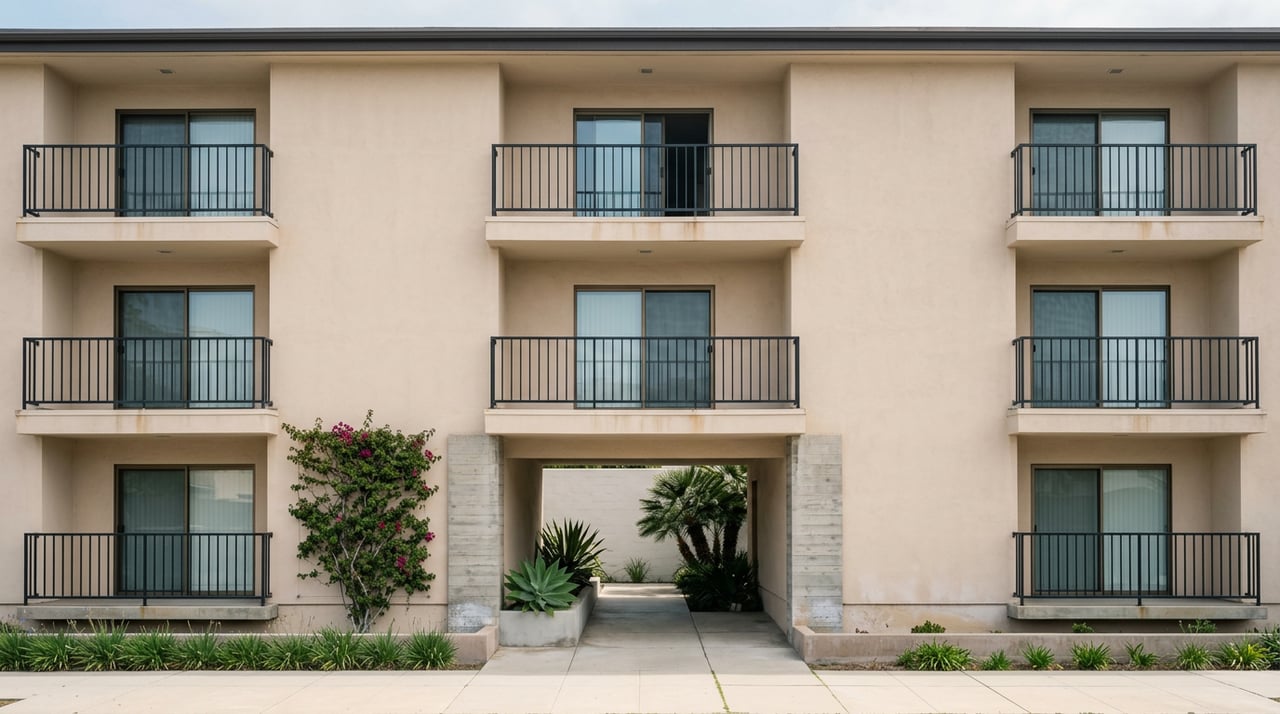
Ten offers came in on a 28-unit building at 901 Ocean Avenue this month, and the sale still had to go through a judge. CBRE arranged the transaction on behalf of a court-appointed receiver, working through the Superior Court of Los Angeles County rather than a standard listing process. The building, constructed in 1961 and 1970 on a 15,011-square-foot double lot with 100 feet of frontage along Ocean Avenue, closed at $23.46 million, with the buyer also assuming roughly $2.4 million in transaction-related obligations. Total consideration landed near $26 million for a coastal apartment asset that most buyers would assume trades on rent roll alone.
It didn't. It traded on something else: the gap between what the building's rents were and what the market would bear once regulatory constraints were properly priced. That gap is the real story in Santa Monica multi-family right now, and it runs through every one of the city's rent control mechanics that catch buyers off guard mid-escrow.
The spread that's widening, not shrinking
The obvious assumption about rent control is that it suppresses value. A building full of below-market, protected tenancies should trade at a discount to a comparable free-market asset. That assumption is only half right, and the half that's wrong is the more important half for anyone underwriting a deal today.
As of Q1 2026, fully stabilized Santa Monica multi-family buildings were trading at cap rates between 5.25% and 6.0%. Value-add buildings, the ones with below-market rents and renovation upside still locked behind rent control ceilings, were trading tighter: 4.25% to 4.75% on current income. That's a meaningfully higher price per dollar of current income for the regulatory complexity, not a discount for it. Buyers aren't avoiding rent-controlled upside. They're competing hardest for it, because the spread between current rent and achievable rent is the asset, not a liability sitting on top of one.
That's why a receivership sale with 10 competing offers isn't a distress signal about Santa Monica multi-family. It's a signal that sophisticated capital already understands the arbitrage and is pricing it in real time. The buyers who lose these deals are usually the ones still underwriting rent control as a flat discount instead of a line-item to model precisely.
What "rent controlled" actually covers, and what it doesn't
The single most common underwriting error on a Santa Monica multi-family deal isn't a math mistake. It's a coverage mistake: assuming a building is subject to the Rent Control Charter Amendment when it isn't, or the reverse.
The rule is narrower than most buyers expect. Coverage turns on two facts: when the certificate of occupancy was issued, and whether the parcel has two or more rental units.
| Property type | Covered by Santa Monica rent control? |
|---|---|
| Multi-unit building, certificate of occupancy before April 10, 1979 | Yes |
| Multi-unit building, built or occupied on or after April 10, 1979 | No (local ordinance does not apply; state AB 1482 may) |
| Single-family home, any age | No, exempt under Costa-Hawkins |
| Condominium, any age | No, exempt under Costa-Hawkins |
Single-family homes and condominiums are exempt from the local ordinance under the Costa-Hawkins Rental Housing Act regardless of construction date. That exemption is exactly why so many buyers assume a duplex or triplex built decades ago behaves like a single-family purchase. It doesn't, if it has two or more units and predates the 1979 cutoff. Confirming which side of that line a target property sits on, before writing an offer, is the first underwriting step that actually matters.
The TORCA wrinkle that still shows up in title
Santa Monica has one more layer that doesn't exist in most other Westside submarkets: the Tenant Ownership Rights Charter Amendment, a 1980s-era program that allowed rent-controlled apartment buildings to convert to condominiums when a sufficient share of tenants agreed to purchase their units. Roughly 3,100 units citywide were converted under TORCA, and many of them still carry rent-level protections today, not full decontrol, unless a specific set of conditions has been met.
Under Costa-Hawkins, a TORCA unit only qualifies for rent-level decontrol once it has been sold for value and is occupied by a tenant who moved in after January 1, 1996, or sits vacant or owner-occupied. As of the city's most recent annual accounting, just over 1,800 of those converted units had qualified for decontrol, the majority owner-occupied, with 28 additional units newly identified as qualifying in a single recent year. That means a meaningful share of TORCA-era condos in Santa Monica are still, in practice, rent-controlled rentals wearing a condominium's paperwork. A buyer who assumes "it's a condo, so it's exempt" without checking the unit's specific decontrol status is underwriting the wrong asset.
The real cost of exiting: what an Ellis Act filing actually runs
For buyers planning a full repositioning, the exit mechanism matters as much as the entry price. The Ellis Act is the only legal path to withdraw a rent-controlled building from the rental market entirely, and Santa Monica's version of that process is more expensive and more procedural than most nearby jurisdictions.
The city requires an owner to obtain a reoccupation permit from the Rent Control Board before a withdrawn building can be put to any use again, a step that doesn't exist in every rent-controlled city. On relocation costs, Santa Monica's figures run well above the baseline:
- Base relocation payments: approximately $23,000 to $24,000 per unit, as of early 2026
- Additional payment for tenants age 62 or older: $4,000 to $5,000 per unit
- Payments are adjusted annually and must be properly documented before any notice is served
For a building with a dozen long-term tenants, that math alone can run into the hundreds of thousands of dollars before construction ever starts. It's a real cost, not a formality, and it belongs in the acquisition model on day one rather than discovered during due diligence.
The number that just changed, two weeks from today
Every Santa Monica multi-family underwriting model has a line for the annual general adjustment, the maximum rent increase the Rent Control Board allows on covered units each year. That number just moved. The Board's Resolution 26-001 sets the 2026 annual general adjustment at 2.6%, with a cap of $70 per month, effective September 1, 2026, up from the prior period's 2.3% adjustment and $60 cap. It's a small change in isolation, three tenths of a percentage point, but it compounds across every controlled unit in a portfolio and it's exactly the kind of detail that separates a current underwriting model from one running on last year's assumptions.
Frequently asked questions
Does a single-family home in Santa Monica fall under rent control? No. Single-family homes are exempt under the Costa-Hawkins Rental Housing Act regardless of age or construction date.
If I buy a rent-controlled apartment building, do I inherit the existing tenants and their rents? Yes. Ownership changes do not reset rent levels or terminate tenancies. The new owner takes the building subject to existing Maximum Allowable Rents and just-cause eviction protections for every covered unit.
I'm buying a condo in a building that converted years ago. Could it still be rent controlled? It's worth checking directly rather than assuming. Units converted under TORCA only lose rent-level protection once specific Costa-Hawkins conditions are met, including a post-1996 tenancy or owner occupancy. Many TORCA-era units remain covered.
What does it actually cost to remove tenants and take a building off the rental market? In Santa Monica, plan on roughly $23,000 to $24,000 per unit in base relocation payments, plus $4,000 to $5,000 more per unit for tenants 62 or older, on top of the procedural requirement to obtain a city reoccupation permit before the building can be reused.
Rent control in Santa Monica isn't a reason to avoid a deal. It's a set of specific, documentable variables that change what a building is worth and how fast that value can be unlocked. The buyers competing for assets like 901 Ocean Avenue understand that distinction. The ones underwriting rent control as a generic discount are the ones losing to 10 other offers.
If you're evaluating a multi-family acquisition on the Westside and want the regulatory and cap rate math run correctly before you write an offer, Hannah Laird Estates can walk through the underwriting with you. Schedule a private consultation.